Brewer Gold-Copper Project

Advancing a Large Gold-Copper System in South Carolina

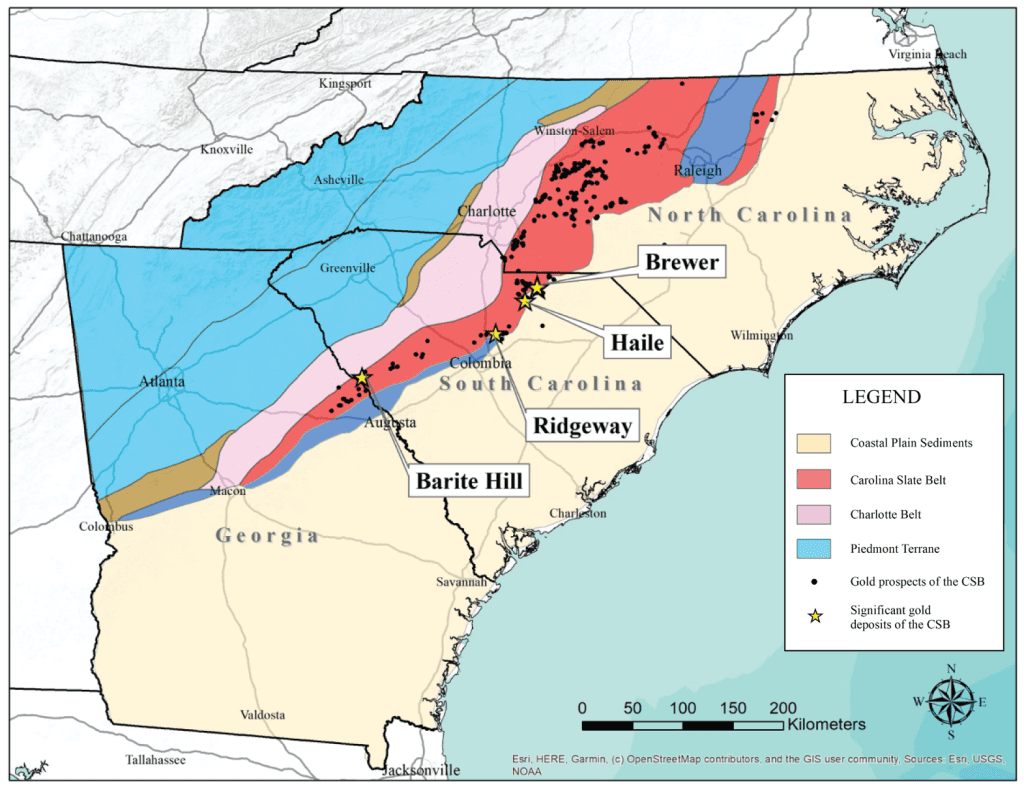
Carolina Rush is advancing the Brewer Gold-Copper Project in South Carolina, a past-producing gold mine located in the prolific Carolina Slate Belt, approximately 13 kilometers from OceanaGold’s Haile Gold Mine.

Brewer hosts a significant high-sulfidation epithermal gold-copper system and an established NI 43-101 mineral resource. Modern exploration is now testing the broader hydrothermal system and the potential for a deeper copper-gold porphyry source.

In 2026, Carolina Rush completed the first systematic deep drilling program designed specifically to test Brewer’s porphyry potential. The three-hole program confirmed a large hydrothermal system, encountered copper-bearing mineralization and significantly refined the geological model toward an area west-northwest of the historic mine that remains largely untested by drilling.

Project Highlights

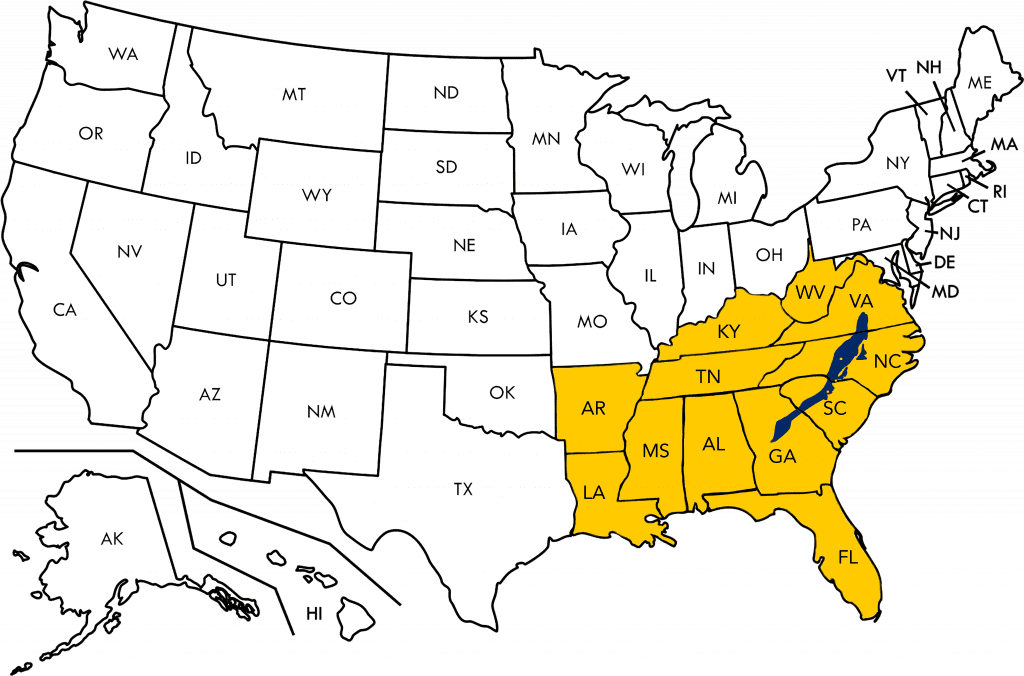
•  Location: Chesterfield County, South Carolina, within the Carolina Slate Belt

•  Historic Production: Approximately 178,000 ounces of gold produced between 1987 and 1995

•  Established Mineral Resource: Gold and copper mineralization defined within both in-situ rock and historic mine backfill

•  Large Hydrothermal System: Exploration has confirmed extensive alteration and mineralization extending well beyond the historic mine

•  Porphyry Exploration Potential: Geological, geochemical and geophysical evidence points toward a potential copper-gold porphyry source

•  OceanaGold Partnership: OceanaGold may earn up to an 80% interest in Brewer by funding US$20 million in exploration expenditures and exercising the underlying Brewer Option

•  Improved Brewer Acquisition Terms: Property acquisition payments are now deferred until permitted mining operations commence and can be paid over ten years

•  District-Scale Land Position: Brewer and Carolina Rush’s adjacent 100%-owned Jefferson Project together form a contiguous 3,480-acre land package

2026 Exploration:
Refining the Search for the Porphyry Source

The 2026 program represented the first systematic deep test of the geological model beneath and surrounding the former Brewer mine.

Three deep holes were completed under Carolina Rush’s earn-in agreement with OceanaGold. The drilling confirmed a kilometer-scale hydrothermal system characterized by strong alteration, locally developed porphyry-style veining and chalcopyrite-bearing copper mineralization.

Importantly, the program provided new geological vectors indicating that the potential centre of the copper-gold system may lie west-northwest of the historic Brewer mine, where drilling remains limited.

Highlights from the 2026 Drill Program

Hole B26C-037
Confirmed a vertically extensive hydrothermal alteration system and encountered copper mineralization, including chalcopyrite, together with locally developed porphyry-style veining.

Hole B26C-038
Provided additional geological information on alteration and mineralization within the broader Brewer hydrothermal system.

Hole B26C-039
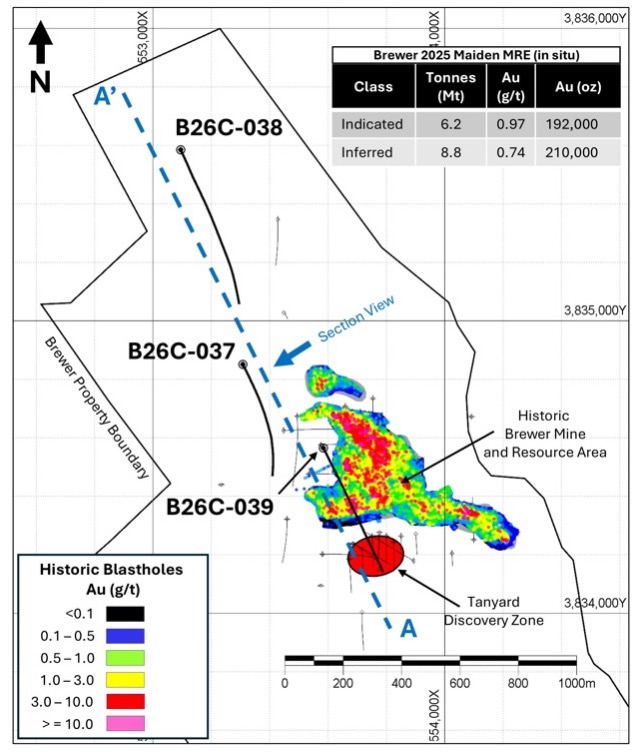
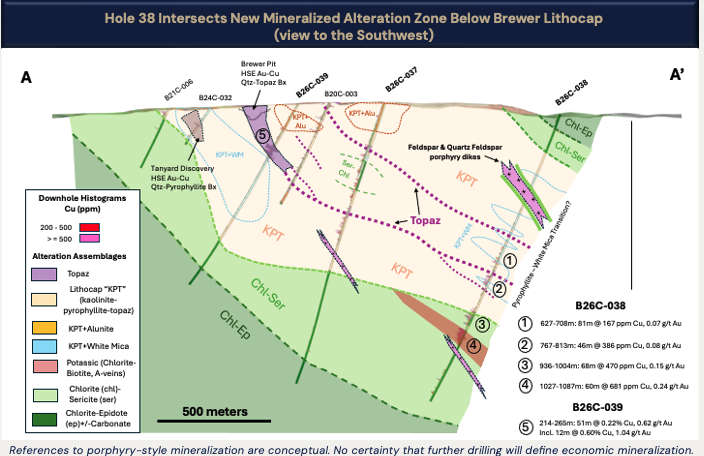
Drilled approximately 400 metres southeast of Hole 37 and west of the former Brewer mine, Hole 39 intersected significant gold-copper mineralization and demonstrated that the Brewer epithermal system extends into an area that had not previously been tested by drilling.

Taken together, the three holes strengthened Carolina Rush’s interpretation of a shallow northwest-dipping alteration system and helped focus future exploration toward the west-northwest.

Maiden Mineral Resource Estimate*

The Brewer Project hosts a maiden NI 43-101 mineral resource estimate covering both mineralization remaining in place beneath and around the former mine and mineralized material contained within historic mine backfill.

Brewer In Situ Mineral Resource

Indicated: 192,000 oz Au and 16.7 Mlbs Cu within 6.2 Mt @ 0.97  g/t Au and 0.12% Cu

Inferred: 210,000 oz Au and 8.3 Mlbs Cu within 8.8 Mt @ 0.74 g/t Au and 0.04% Cu


Brewer Backfill Mineral Resource

Inferred: 139,000 oz Au and 9.7 Mlbs Cu within 11.9 Mt @ 0.36 g/t Au and 0.03% Cu


* The Brewer maiden mineral resource estimate was prepared under National Instrument 43-101 (“NI 43-101”) standards by Independent and Qualified Person (QP), Patrick J. Hollenbeck. The Mineral Resource Estimate  was constructed using all available drilling information available for the Brewer project, including Carolina Rush core drilling (n = 36); Carolina Rush rotary airblast drilling (n = 194); Historical drilling (n = 1,020); and Historical production blastholes (n = 49,926). The  in-situ Brewer Mineral Resources are reported at a 0.5 g/t Au cutoff considered for “reasonable economic extraction” and were calculated using a 3-year gold price (Jan. 2022 – Dec. 2024) of US$2,045/oz and an assumed all-in mining and processing cost of US$33/tonne.

*No grade sensitivity analysis was conducted for the backfill resource model; the reported resource does not apply a cutoff grade as it assumes that all backfill material will need to be removed and processed to support mining of the in-situ resource below the backfill.  Details on the metallurgical properties and processing methods required to extract gold and copper from the backfill material have not been undertaken. As such, the Backfill resource is considered theoretical and additional studies are required to report the inferred resources at a higher level of confidence.

A Large Hydrothermal Gold-Copper System

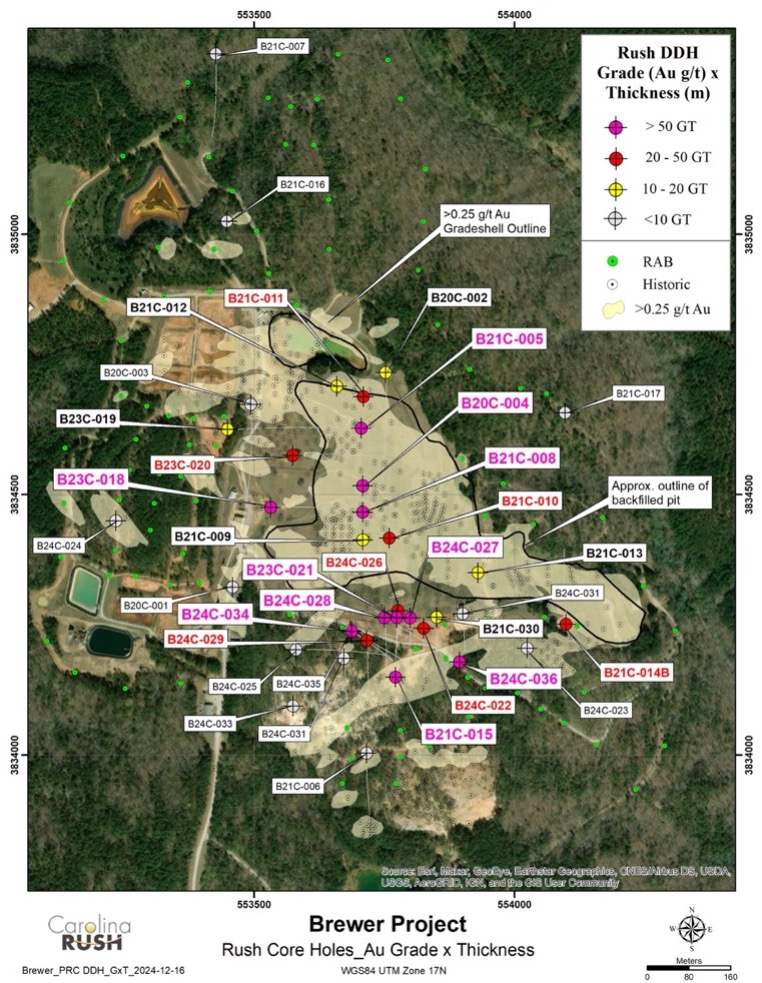
Brewer was historically mined as an oxide gold deposit. Open-pit mining reached depths of approximately 65 meters, where sulfide-hosted gold and copper mineralization was encountered but could not be processed by the historic heap-leach operation.

Modern exploration has demonstrated that mineralization extends considerably beyond the footprint and depth of the former mine.

Carolina Rush’s geological model interprets Brewer as a high-sulfidation epithermal gold-copper system associated with a much larger magmatic-hydrothermal system.

This model is supported by:

•  Extensive hydrothermal alteration

•  Gold-copper mineralization across multiple target areas

•  Porphyry-style veining encountered at depth

•  Molybdenum and copper geochemical vectors

•  Deep IP and magnetotelluric geophysical anomalies

•  Geological vectors identified by the 2026 drill program

Exploring Beyond the Historic Brewer Mine

One of the most important developments in 2026 was Carolina Rush’s expansion of the Jefferson Project, immediately west and northwest of Brewer.

Carolina Rush secured nine new mineral leases covering 2,524 acres, expanding Jefferson and creating a 3,480-acre contiguous land package when combined geographically with Brewer.

The Jefferson Project is 100%-owned by Carolina Rush and is separate from the Brewer Project and OceanaGold earn-in agreement.

The expanded land position gives Carolina Rush control over ground immediately along the interpreted direction of the broader Brewer hydrothermal system and provides additional flexibility for future district-scale exploration.

Partnership with OceanaGold

Carolina Rush entered into an earn-in agreement with OceanaGold Corporation in September 2025 to advance exploration at Brewer.

Under the agreement, OceanaGold may earn:

50% interest
by funding a total of US$8 million in project expenditures by December 31, 2027

Up to 80% interest
by funding an additional US$12 million by December 31, 2030

The agreement also provides OceanaGold with the ability to exercise Carolina Rush’s underlying option to acquire the Brewer property.

OceanaGold has satisfied its initial minimum US$1.5 million exploration expenditure commitment, which funded the initial 2026 deep drilling program.

Improved Brewer Property Acquisition Terms

In August 2026, Carolina Rush executed the Sixth Amendment to its underlying Brewer Option Agreement with the Brewer Gold Receiver.

The amendment significantly changed the timing of the estimated US$27 million property acquisition payment.

Previously, certain acquisition costs would have become payable at closing. Under the amended agreement:

•  No cash acquisition payment is required at closing

•  Payments begin only if and when new mining operations are fully permitted

•  The estimated purchase amount is payable in 10 equal annual installments

•  Financial assurance at closing may be satisfied through approved non-cash mechanisms

Strategically Located in the Carolina Slate Belt

Brewer is situated within the Carolina Slate Belt, an established gold-producing region extending through portions of North Carolina and South Carolina.

The project lies approximately 13 kilometes from the Haile Gold Mine, one of the largest operating gold mines in the eastern United States.

Brewer also benefits from established infrastructure associated with its history as a producing mine, including:

•  Paved road access

•  Internal site roads

•  Nearby electrical infrastructure

•  Existing water-management infrastructure

•  Extensive previously disturbed areas associated with historic mining

Why Brewer

A Known Gold Resource. A Much Larger Geological Question.

• Historic mining established Brewer as a gold deposit.

•  Modern exploration has shown that Brewer is part of a considerably larger gold-copper hydrothermal system.

•  The next phase of exploration is focused on understanding the scale of that system and testing the geological vectors identified by drilling, geophysics and geochemistry beyond the limits of the historic mine.

•  That is the core Brewer story.

Brewer Phase I Deep Drill Program
Layton Croft discussing Brewer's Maiden MRE
Hole 38 Intersects New Mineralized Zone Below Lithocap (View to the Southwest)
Brewer-Jefferson Land
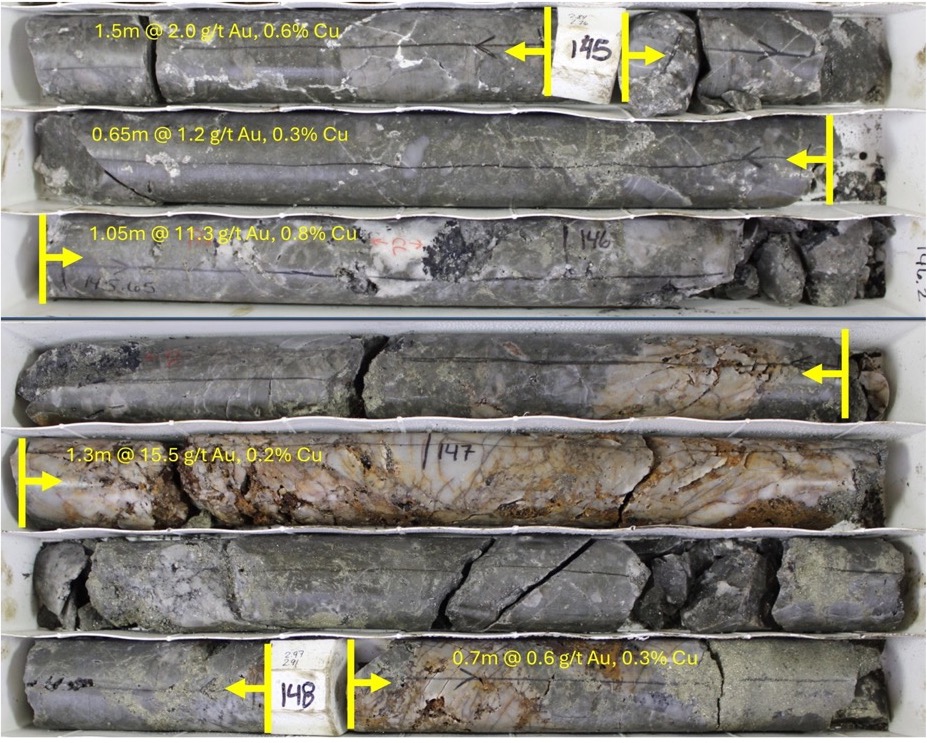
Summary of Best Intersections at Brewer

Photo Gallery

Location Map
Sonic Drill Rig at Brewer
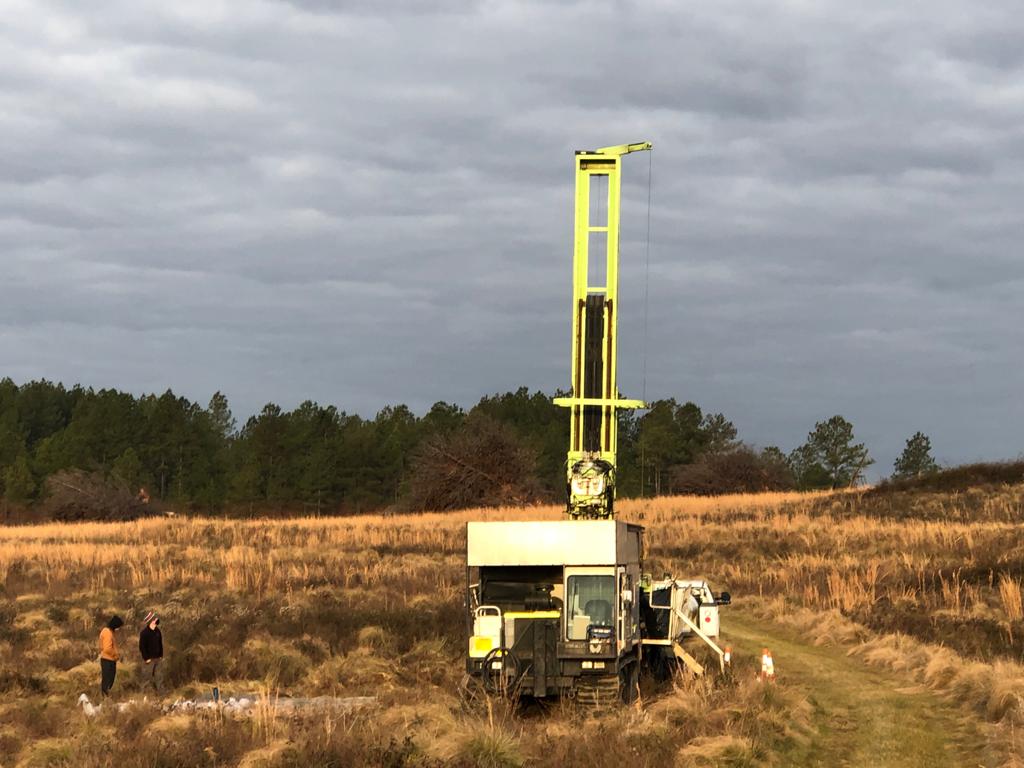
Photo of mining equipment in a field
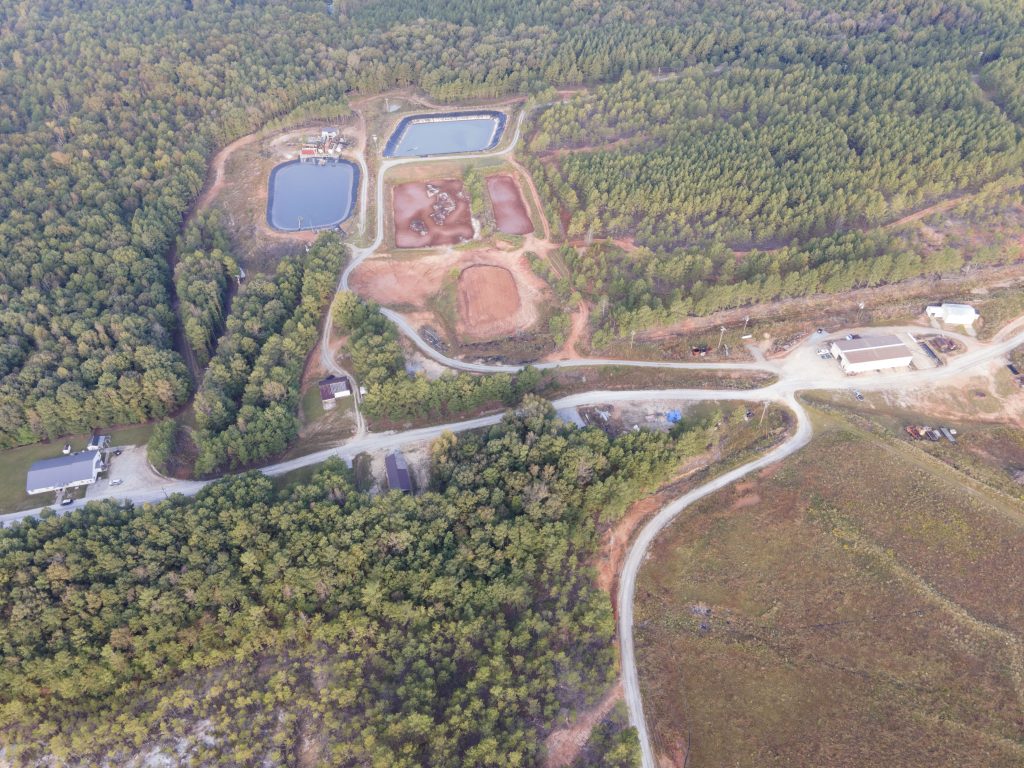
Brewer's Aerial View
Arial view of the Brewer Gold mine and the surrounding area
B21C-016: 223m - Chalcopyrite + Bornite
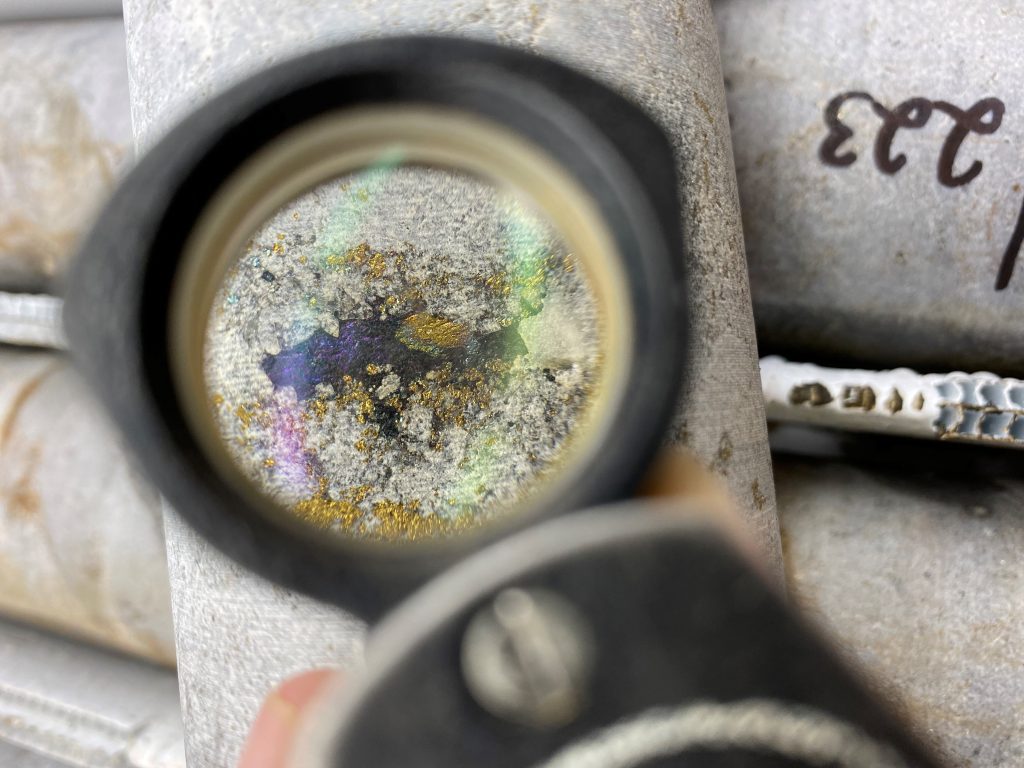
uncut gold under magnifying glass
Mineralization encounter in Hole B23C-021
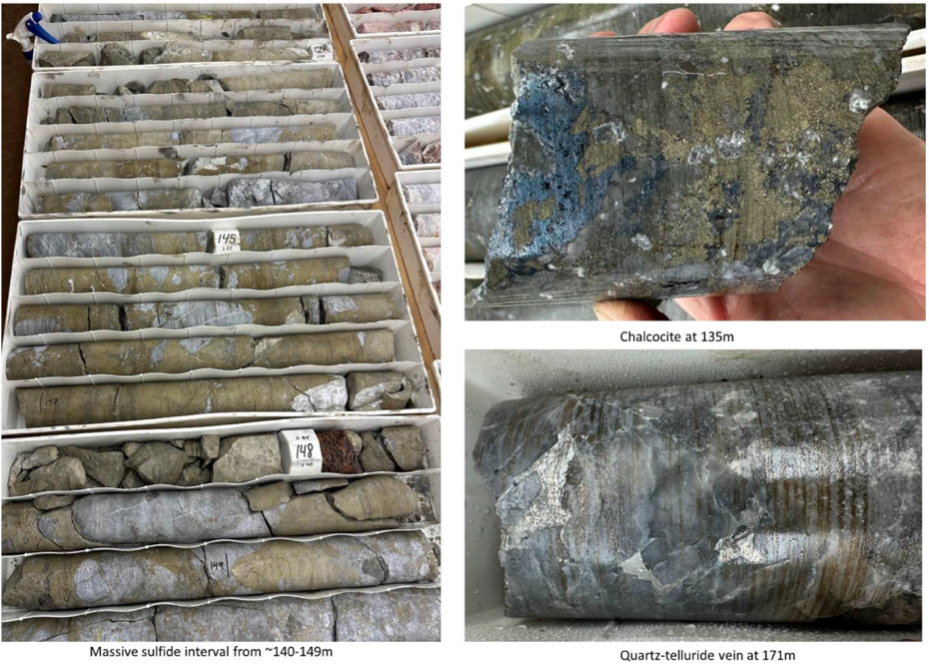
B24C-034: 145 to 148 meters