
Carolina Rush Confirms Kilometer-Scale Hydrothermal System at Depth and Identifies Copper Porphyry Vectors at Brewer Project
Toronto, Ontario, May 4, 2026: Carolina Rush Corporation (“Carolina Rush” or the “Company”) (TSXV: RUSH / OTCQB: PUCCF) reports on its recently completed initial 3-hole deep drill program at the Brewer Gold-Copper Project in South Carolina, USA, implemented in partnership with OceanaGold Corporation (“OceanaGold”) (TSX: OGC / NYSE: OGC) under an earn-in agreement of up to US$20 million in exploration expenditures (see news release dated September 16, 2025).
The program represents the first systematic test of Brewer’s porphyry potential and was designed to evaluate the source of Brewer’s large hydrothermal system. Drilling has confirmed key elements of the Company’s geologic model and materially refined targeting toward a potential porphyry copper-gold discovery.
Results from B26C-037 (Hole 37) confirm the presence of a large, vertically extensive hydrothermal system characterized by consistent alteration zonation, local porphyry-style veining, and chalcopyrite-bearing copper mineralization. Anomalous chalcopyrite in Hole 37 is notably elevated relative to background levels at Brewer, representing a different mineral assemblage from the known copper mineralization below and near the former mine, which is not chalcopyrite-bearing. Reinterpretation of geophysical data indicates the low resistivity magneto-telluric (MT) anomaly that was targeted represents a peripheral alteration zone, refining the Company’s targeting toward higher-priority areas to the northwest, where the system appears to strengthen.
Carolina Rush CEO Layton Croft stated: “Background copper levels at Brewer are less than 50 parts per million (ppm). Hole 37 intersected 410 meters averaging 183 ppm copper, predominantly chalcopyrite, within the top 600 meters. Together with Hole 37’s B-type veining and alteration zonation, these results confirm we are clearly within a magmatic-hydrothermal system. While we have not yet identified a porphyry source, our initial deep drilling has materially advanced our understanding of the system and, importantly, refined our targeting towards where we believe such a source may exist. Porphyry copper deposits are typically discovered over multiple drill campaigns, and we are encouraged by our first. Just as important, the scale and continuity of Brewer’s large alteration footprint confirm that the hydrothermal system extends laterally and at depth well beyond the limits of the historic mine, supporting potential for additional gold and copper discovery across the property.”
PROGRAM HIGHLIGHTS
System Confirmed at Depth
- Over 3,579 meters of drilling completed across three holes, representing the first systematic deep drill program at Brewer;
- Drilling confirms an extensive hydrothermal alteration system that thickens to the northwest and extends to depths exceeding one kilometer;
- Hole 37 intersected 410 meters of elevated copper averaging 183 ppm Cu from 198 meters depth, significantly above background levels (<50 ppm Cu); and
- Copper mineralization is predominantly hosted in chalcopyrite, the primary copper mineral associated with porphyry copper systems, indicating a higher-temperature hydrothermal environment distinct from Brewer’s known near-surface mineralization.
Porphyry-Style Features Identified
- Banded quartz-sulfide veining interpreted as “B-type” veins are associated with magmatic-hydrothermal fluid pathways in porphyry systems, and were observed over multiple intervals in Hole 37;
- Multiple late- to inter-mineral porphyry dikes intersected, confirming multi-phase intrusive activity; and
- Predictable, well-developed alteration zonation (quartz-pyrophyllite-topaz to sericite-chlorite to chlorite-epidote) observed across multiple holes, consistent with magmatic-hydrothermal systems.
Vectoring Refined and Targeting Improved
- Reinterpretation of MT geophysical data indicates that the anomalies reflect alteration contrast rather than a causative intrusive body; and
- Updated geologic model supports a northwest vector towards a potential porphyry center.
Large Alteration Zone – Untested Potential
- The confirmed scale of alteration extends well beyond the footprint of Brewer’s known mineral resource, indicating the broader system remains largely untested; and
- Epithermal gold systems like Brewer are commonly associated with large magmatic-hydrothermal systems, highlighting additional exploration opportunities for epithermal gold mineralization.
Advancing Towards Next Phase
- Results from B26C-038 (Hole 38) and B26C-039 (Hole 39) are pending;
- Integrated geological, geochemical and geophysical interpretation underway; and
- Future drilling will be informed by targets defined through updated geological, geochemical, and geophysical vectoring.
DRILL PROGRAM SUMMARY
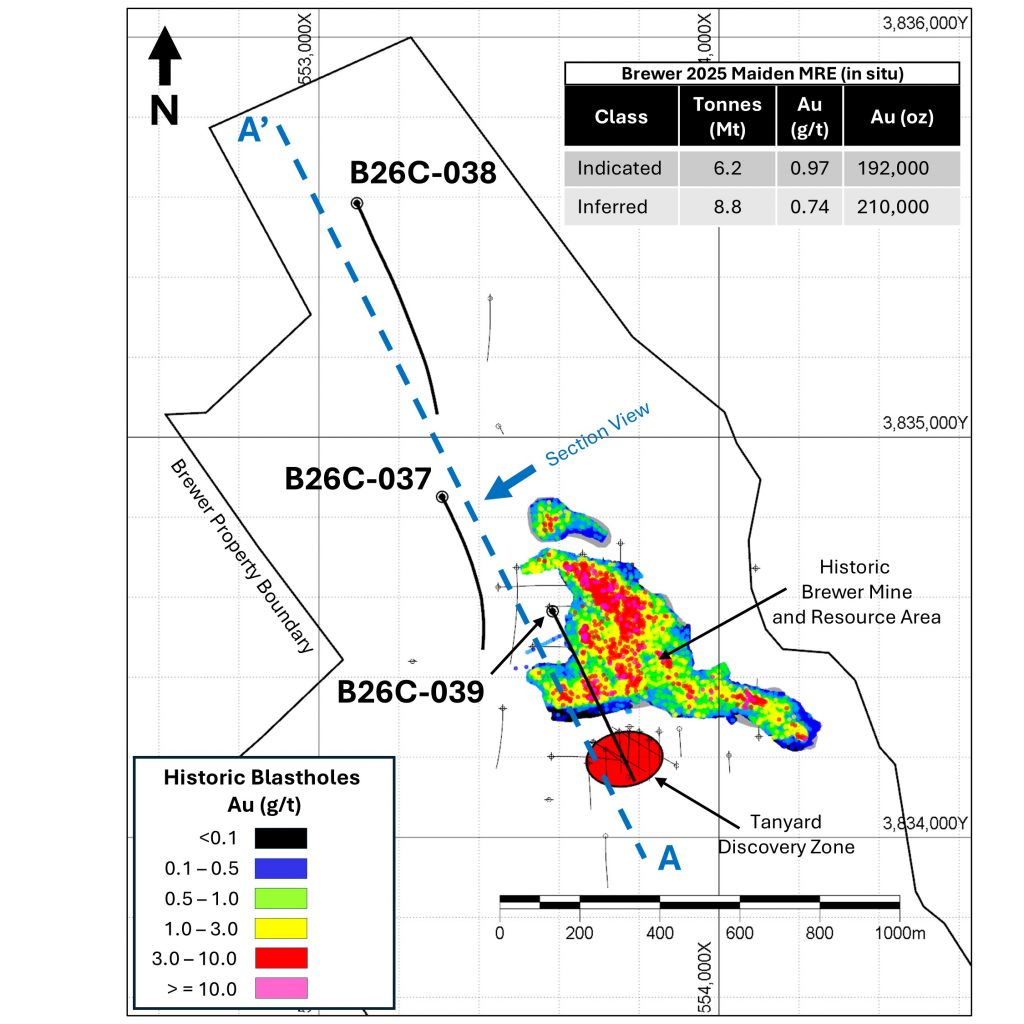
The initial deep drill program was designed to test geological and geophysical targets within Brewer’s large alteration footprint, with a focus on the deep potential of the known high-sulfidation system (see Figure 1). Specifically, Holes 37 and 39 targeted a large low-resistivity anomaly identified from the Company’s MT and induced polarization (IP) geophysical survey completed at Brewer in March 2025, interpreted as a potential hydrothermal conduit below and west of the former mine. Hole 38 tested the northwestern extension of the hydrothermal system. All three holes were drilled on the same azimuth (155°), at angles of 60–70 degrees. Drilling, conducted by Timberline Drilling Inc., commenced January 6, 2026, and concluded April 16, 2026.
Analytical results for Hole 37 have been received and are reported herein. Results for Holes 38 and 39 are pending. Completed drilling includes:
- Hole 37: 1,288 meters
- Hole 38: 1,374 meters
- Hole 39: 917 meters
Deep drilling has consistently intersected a thick sequence of zoned hydrothermal alteration: advanced argillic (quartz–pyrophyllite-topaz) near surface, quartz–sericite–pyrite ± chlorite at intermediate depths, and chlorite–epidote-carbonate at depth. This zonation is consistent across multiple drill holes, and the altered rock package appears to thicken to the northwest, supporting the interpretation of a tilted, northwest-dipping alteration system.
Figure 1: Location of Phase 1 Deep Drill Program Holes
RESULTS FROM HOLE 37
Hole 37 was drilled to a final depth of 1,288 meters and tested the large low-resistivity anomaly identified by the Company’s 2025 MT-IP geophysical survey (see Figure 2). Drilling indicates the geophysical anomaly reflects the contrast between resistive advanced argillic (quartz-pyrophyllite-topaz) altered rocks and the more conductive quartz-sericite-pyrite alteration below, rather than a causative intrusive body. This reinterpretation suggests the MT anomaly represents a distal alteration envelope — consistent with the Company’s geologic model that suggests Brewer’s Au-Cu mineralization was sourced from the northwest and at depth. These observations informed the decision to collar Hole 38 approximately 750 meters to the northwest of Hole 37.
Key geological observations from Hole 37 informing the Company’s Brewer exploration model include:
- Chalcopyrite-bearing copper mineralization: A 410-meter interval of elevated copper (average 183 ppm Cu) was encountered from 198 meters depth, including 78 meters averaging 260 ppm Cu from 538 meters, and 14 meters averaging 490 ppm Cu from 592 meters (see Figure 3). Copper is predominantly hosted in chalcopyrite — the primary copper mineral associated with porphyry deposits — and associated with a zone of chlorite-sericite alteration; both of which are interpreted to represent a higher-temperature assemblage relative to Brewer’s known near-surface high-sulfidation mineralization. Background copper levels at Brewer are typically <50 ppm; the 410-meter interval represents a significant departure from this baseline, despite no economic levels of gold-copper mineralization being identified in Hole 37.
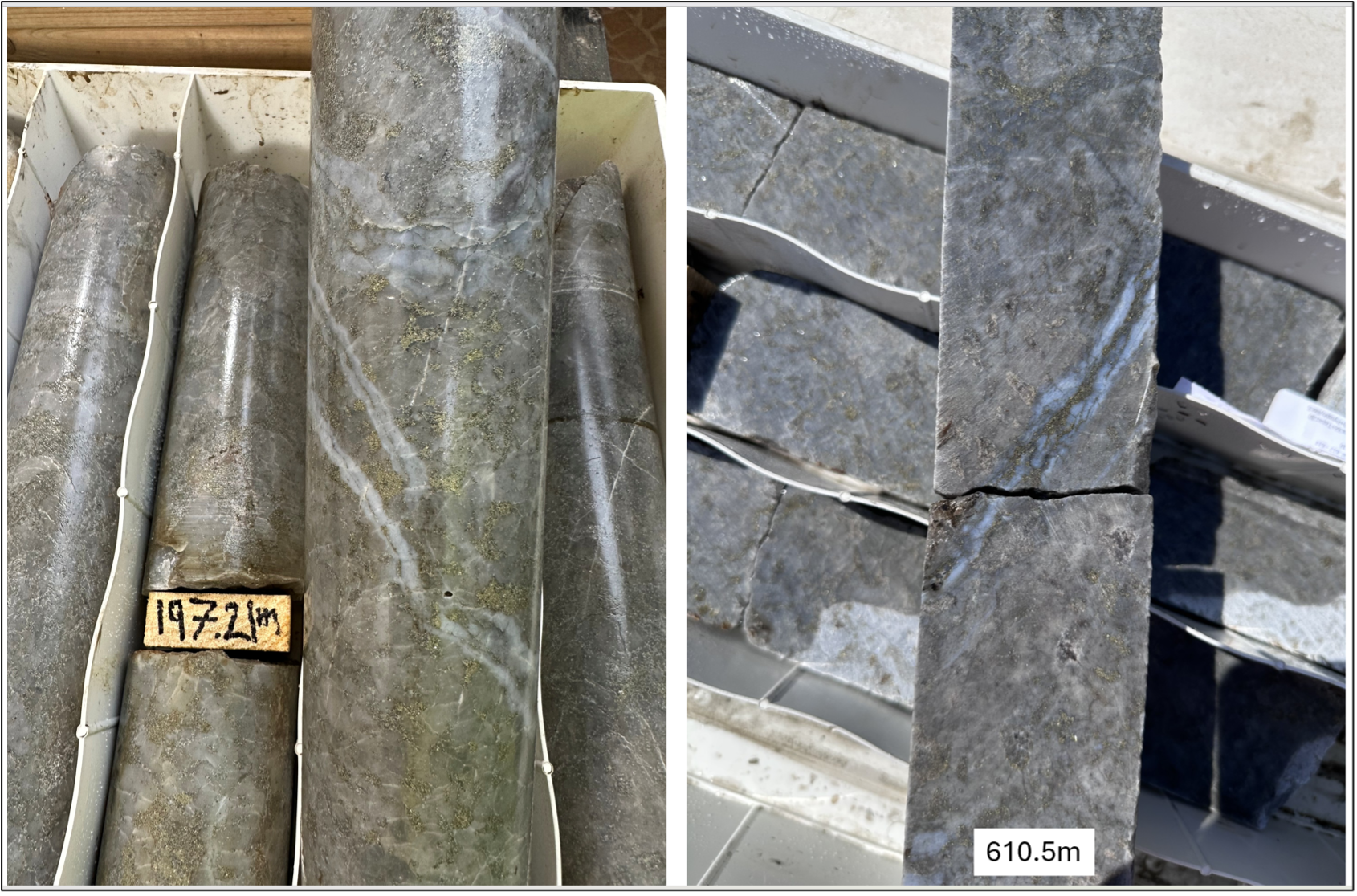
- Quartz veinlets: Banded quartz with MoS2 (BMQ) and quartz-sulfide (B-type) veins are associated with magmatic-hydrothermal fluid pathways in porphyry systems and were observed across multiple intervals (see Figure 4). The highest vein density occurred between 170–223 meters and again between 570–640 meters, correlating with the upper and lower extents of the elevated copper-gold zone. Where present, vein centerlines contain pyrite and, less commonly, molybdenite.
- Alteration zonation: A predictable transition from advanced argillic to sericite-chlorite underlain by chlorite-epidote alteration is consistent with movement away from a higher-temperature hydrothermal core, and provides a vector for ongoing targeting. Chlorite-epidote alteration in the lower third of Hole 37, coupled with low metal values, may define a southern boundary for porphyry potential at depth.
The Company emphasizes that references to porphyry-style mineralization are conceptual and exploratory in nature, and there is no certainty that further drilling will define economic mineralization.
Figure 2: MT-IP Line 3 Resistivity section (looking SW) and location of deep drill holes
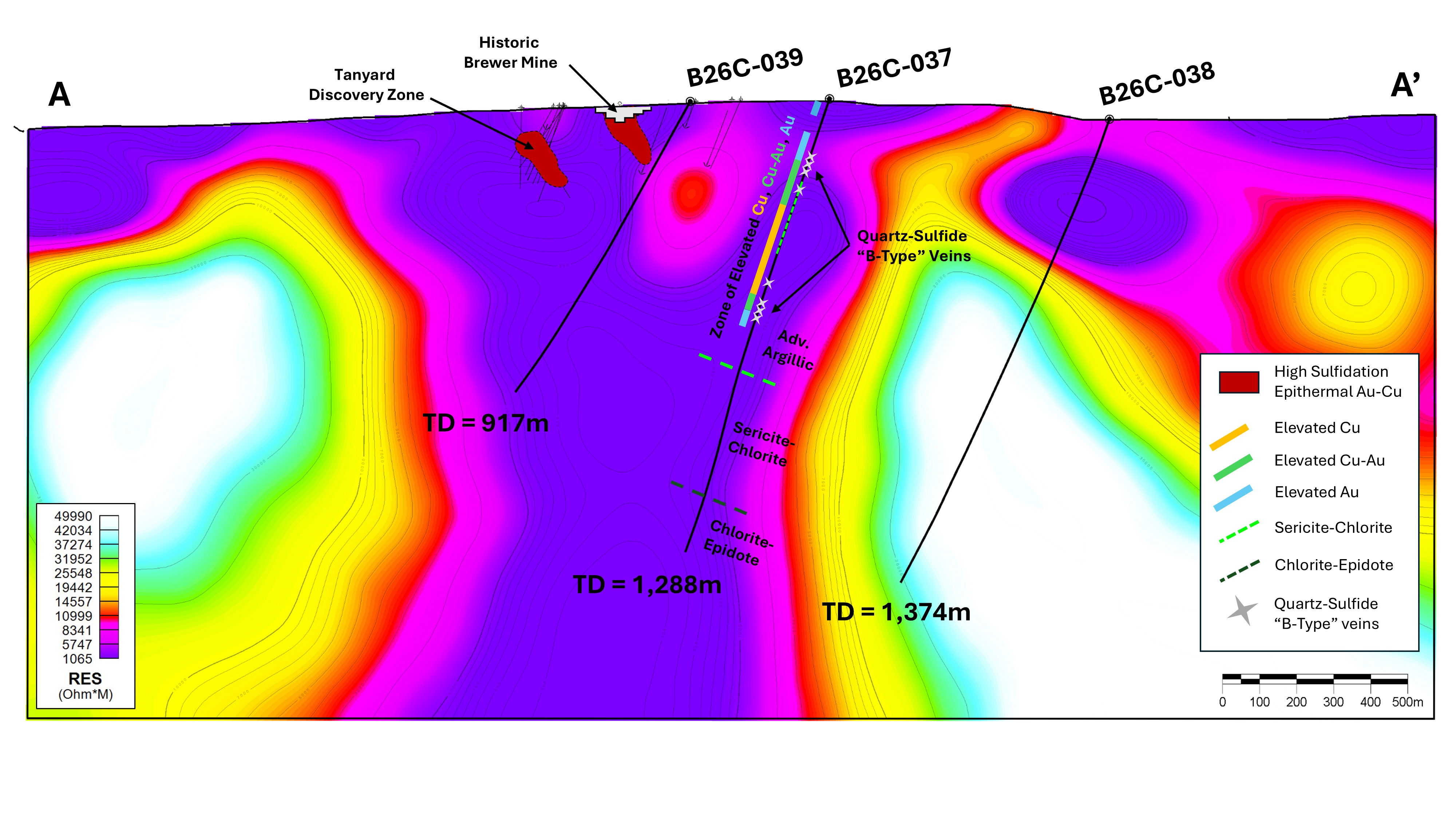
Figure 3: Core photos of chalcopyrite in Hole 37
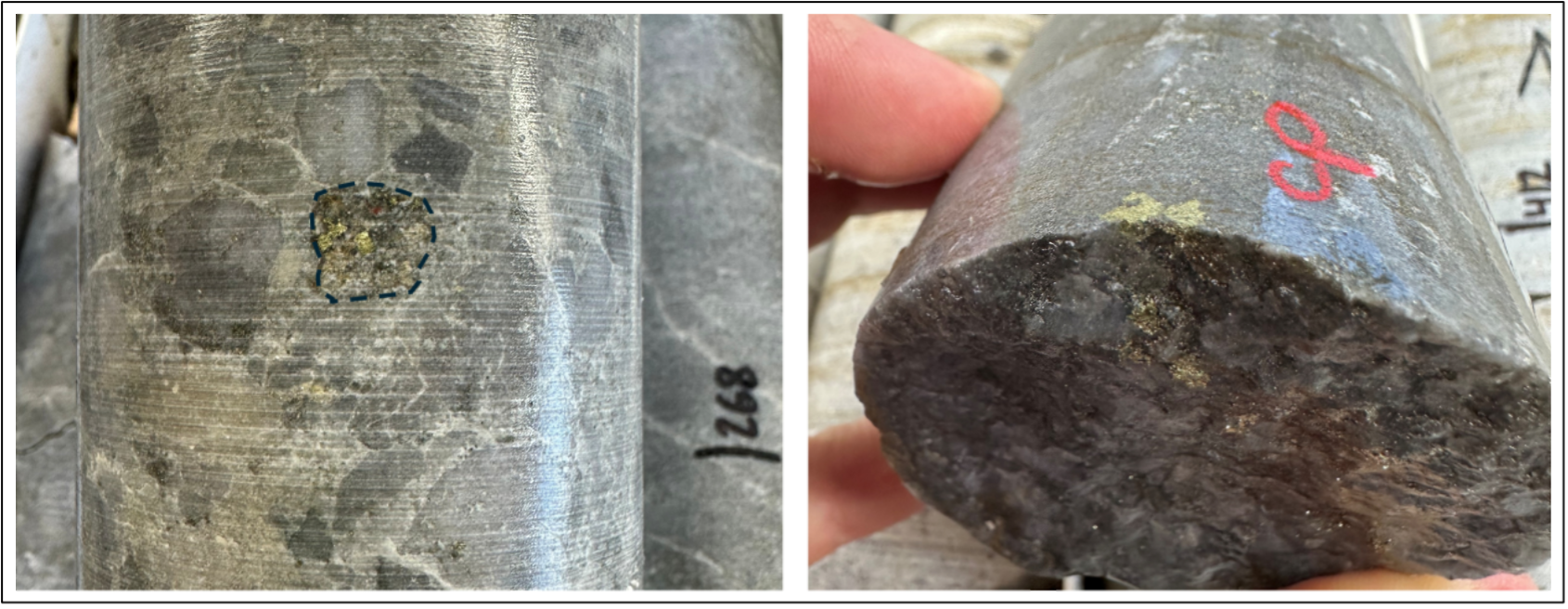
Figure 4: Core photos of quartz-sulfide “B-type” veins in Hole 37
INTERPRETATION AND NEXT STEPS
The initial deep drill program confirmed the scale and continuity of Brewer’s hydrothermal system and provided important constraints on the geometry and vectoring of mineralization at depth. While a porphyry center has not yet been identified, the program has refined the Company’s exploration model and narrowed the search toward areas where the system appears to strengthen. Porphyry copper-gold systems are typically defined over multiple drill campaigns — the data generated by this program materially advances the Company’s ability to target the next phase with increased confidence.
Once results from Holes 38 and 39 are received, they will be interpreted and integrated into the Company’s exploration model. Next steps will focus on integrating geological, geochemical, and geophysical datasets to refine understanding of the system, especially areas to the northwest where alteration thickening, geophysical response, and geochemical indicators suggest increasing proximity to a potential porphyry source.
OceanaGold Partnership
The Brewer Gold-Copper Project is currently being explored in partnership with OceanaGold under an earn-in agreement whereby OceanaGold may earn an 80% interest in Brewer by funding US$20 million in exploration expenditures and exercising Carolina Rush’s underlying Brewer Option before the end of 2030. It is expected that in Q2 2026 OceanaGold will have satisfied its minimum US$1.5 million exploration expenditure commitment under the earn-in agreement. To earn a 50% interest in Brewer, OceanaGold must spend a total of US$8 million by December 31, 2027.
Qualified Person Statement
The technical information in this news release has been prepared in accordance with Canadian regulatory requirements as set out in NI 43-101 and reviewed and approved by Patrick Quigley, MSc, CPG-12116, the Company’s Senior Geologist and Exploration Manager and a Qualified Person as defined by NI 43-101.
About Carolina Rush
Carolina Rush Corporation (TSXV: RUSH / OTCQB: PUCCF) is a mineral exploration company focused on the discovery of gold and copper deposits in the southeastern United States. The Company is advancing the Brewer Gold-Copper Project in Chesterfield County, South Carolina — a large, underexplored hydrothermal system with a near-surface epithermal gold NI 43-101 mineral resource and compelling exploration potential for deeper porphyry copper-gold mineralization. Brewer is currently being explored in partnership with OceanaGold Corporation (TSX: OGC / NYSE: OGC) under a US$20 million earn-in agreement. Brewer is located 13 km from OceanaGold’s producing Haile Gold Mine. Information from nearby properties is not necessarily indicative of the mineralization at Brewer.
For further information, please contact:
Layton Croft, President and CEO
or
Jeanny So, Corporate Communications Manager
T: +1.647.202.0994
For additional information please visit our website at http://www.TheCarolinaRush.com/ and our X feed: https://twitter.com/TheCarolinaRush.
Neither TSX Venture Exchange nor its Regulation Services Provider (as that term is defined in the policies of the TSX Venture Exchange) accepts responsibility for the adequacy or accuracy of this release.
This news release contains forward-looking information which is not comprised of historical facts. Forward-looking information is characterized by words such as “plan”, “expect”, “project”, “intend”, “believe”, “anticipate”, “estimate” and other similar words, or statements that certain events or conditions “may” or “will” occur. Forward-looking information involves risks, uncertainties and other factors that could cause actual events, results, and opportunities to differ materially from those expressed or implied by such forward-looking information. Factors that could cause actual results to differ materially from such forward-looking information include, but are not limited to, changes in the state of equity and debt markets, fluctuations in commodity prices, delays in obtaining required regulatory or governmental approvals, and other risks involved in the mineral exploration and development industry, including those risks set out in the Company’s management’s discussion and analysis as filed under the Company’s profile at www.sedarplus.ca. Forward-looking information in this news release is based on the opinions and assumptions of management considered reasonable as of the date hereof, including that all necessary governmental and regulatory approvals will be received as and when expected. Although the Company believes that the assumptions and factors used in preparing the forward-looking information in this news release are reasonable, undue reliance should not be placed on such information. The Company disclaims any intention or obligation to update or revise any forward-looking information, other than as required by applicable securities laws.